
Starting strength training at home with dumbbells

By Greg Benson
A useful home setup gives you room to move, stable support, and weights you can control. Begin with the exercises that fit that setup, practice them consistently, and use your log to decide when a small increase is justified.
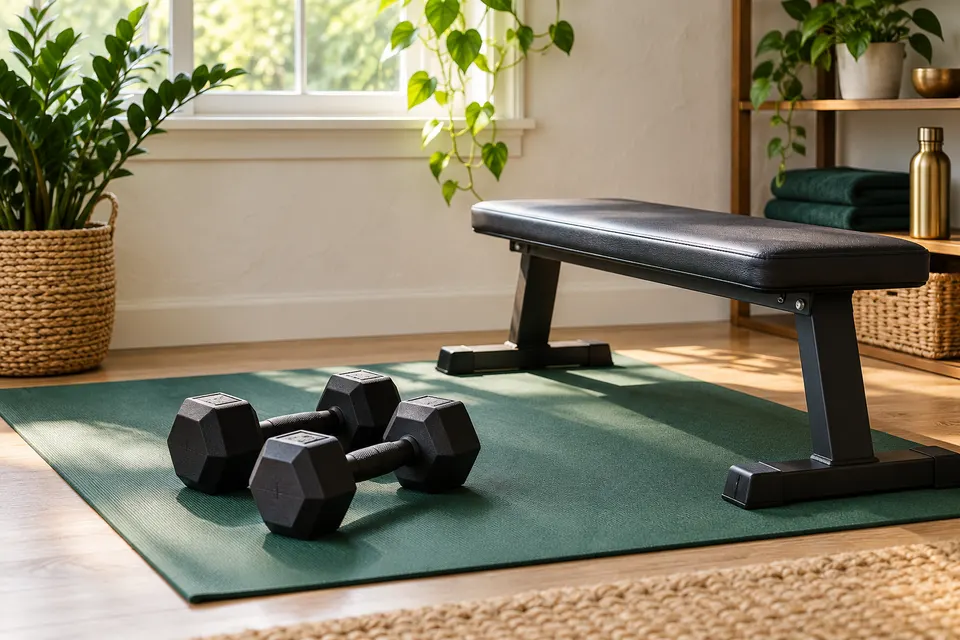
Check the space before buying equipment
Clear enough floor space to lie down, hinge at the hips, and move a weight without hitting furniture. Check that the floor is not slippery and that any bench or support is stable and suitable for the load. A chair on wheels is not a training bench.
The full dumbbell/home program uses dumbbells, a bench, and bands. The starter includes alternatives such as a floor press where a bench is unavailable. Read the exercise options before deciding whether your current setup covers the plan.
A complete sample: home Workout A
This is Workout A from the free starter, with a floor press and plank selected from its options. First do 3–5 minutes of easy movement and one or two lighter practice sets for the first loaded exercise. During days 1–14, stop working sets with about three or four controlled reps still available.
For the plank, stop while you can still hold your position and breathe; do not translate reps in reserve into seconds. The starter also includes Workouts B and C. Repeat the A/B/C sequence on non-consecutive days rather than doing this same session every day.
| Exercise | Working sets and target | Setup note |
|---|---|---|
| Goblet squat to a box or bench | 2 × 10–15 reps | Use a stable target and a controlled depth |
| Dumbbell floor press | 2 × 8–15 reps | Control the descent and keep the setup repeatable |
| One-arm dumbbell row | 2 × 10–15 reps per side | Use stable support and avoid twisting the torso |
| Dumbbell Romanian deadlift | 2 × 10–15 reps | Move the hips back; do not force depth |
| Dumbbell lateral raise | 2 × 12–20 reps | Choose a load that does not require swinging |
| Plank | 2 × 20–45 seconds, as control allows | Maintain your position while breathing; stop earlier if needed |
Can you start without a bench?
For Workout A above, a floor press is the listed alternative to a bench press. A row still needs a support that will not tip, slide, or collapse under the way you use it. Check the setup before adding weight; household furniture is not automatically suitable for exercise.
Check Workouts B and C before committing to the full home track. They include movements that may need an incline bench, bands, a stable step, or an appropriate alternative. A workable floor-press setup does not mean you have covered every exercise in the whole program.
One dumbbell weight will not fit every exercise
A weight that is manageable for a squat can be too heavy for a lateral raise. Adjustable dumbbells or several pairs make it easier to choose an appropriate load. Do not force a small-muscle exercise to use the weight that happened to work for a different movement.
If you cannot control the lightest available weight, use the program's easier variation or choose the bodyweight track. If you cannot perform a movement comfortably, get help with the setup or use a suitable alternative rather than pushing through pain.
Progress with the equipment you have
Record the weight and repetitions for each working set. Repeat the same setup on the next exposure so the comparison means something. Follow the program's progression rule once you can complete the prescribed range with the intended effort and good control.
When the next available dumbbell is a large jump, improving controlled repetitions within the target range may be the better next step. Avoid adding weight, extra sets, and harder variations all at once; it becomes difficult to tell what changed your performance.
A worked example of increasing the weight
The home program uses double progression: build reps within the assigned range, then add the smallest practical amount of weight once all working sets reach the top with the intended effort and control. Keep the first two weeks conservative; this example explains the rule, not a deadline to increase.
Illustrative log for an exercise with two sets of 10–15 reps: at 20 lb, you record 12 and 11 reps. On later sessions you gradually reach 15 and 15 at the required effort. You can then try the next small increment. If that leaves you unable to reach 10 controlled reps, the jump is too large for that exercise at this point; keep the previous load instead of forcing it.
Write down whether a dumbbell weight means each hand or the total. Also record changes in range, support, or tempo. Those changes affect the comparison even when the number printed on the dumbbell stays the same.
Make the next session easy to start
Keep your log and the next workout where you train. Choose a time that does not depend on the room being unexpectedly empty. Return the equipment to a safe place afterward, especially around children or pets.
The useful test of a home setup is whether you can repeat the planned work safely. More equipment becomes useful when it solves a specific limitation in your routine.
Sources and program context
Keep learning
Put the first two weeks on your calendar
Get the free starter with six workouts, equipment options, food basics, and a Day 1 baseline.
Start with 14 days free