A three-day beginner workout week: schedule, effort, and a sample

By Greg Benson
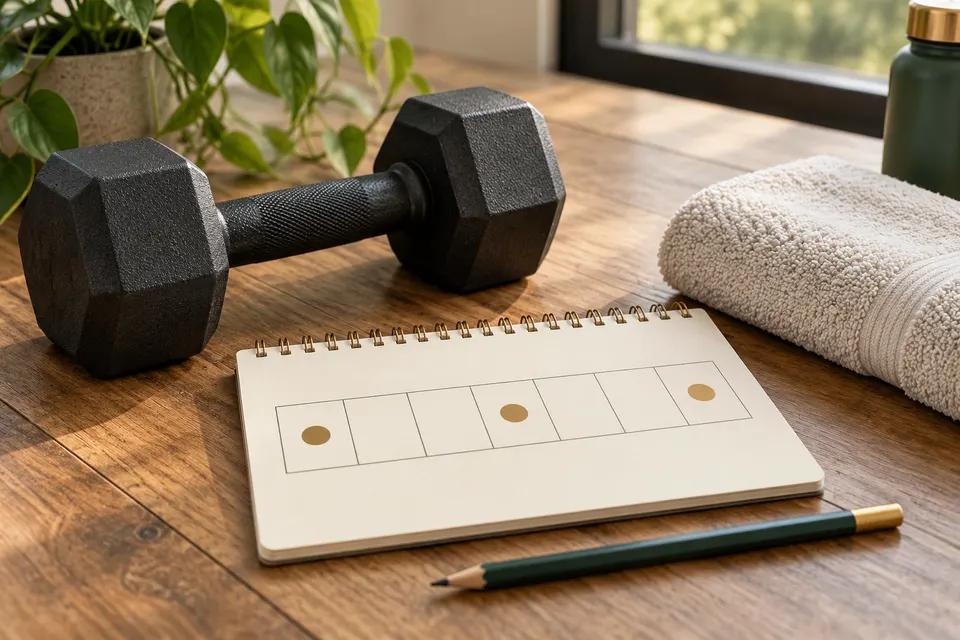
The starter rotates Workout A, B, and C on non-consecutive days, then repeats the sequence in week two. Each session has a manageable amount of work, an easy warm-up, and a log of the weights and repetitions you completed.
What a week looks like
This is the first-two-weeks structure from the free Get Fit Before 40 starter. The full 90-day program later changes the training structure; this table describes the starting phase.
| Day | Plan |
|---|---|
| Monday | Workout A |
| Tuesday | Rest or an easy walk |
| Wednesday | Workout B |
| Thursday | Rest or an easy walk |
| Friday | Workout C |
| Weekend | Recovery; optional easy activity |
Sample: the starter's full-gym Workout A
These are the working sets from the free starter. Use lighter practice sets first. The two core options use different units: a plank is timed; a dead bug is performed as slow, controlled repetitions.
| Exercise | Working sets | Target |
|---|---|---|
| Leg press | 2 | 12–15 repetitions |
| Machine chest press | 2 | 10–15 repetitions |
| Seated cable row | 2 | 10–15 repetitions |
| Seated or lying leg curl | 2 | 12–15 repetitions |
| Cable lateral raise | 2 | 12–20 repetitions |
| Plank | 2 | 20–45 seconds, as control allows |
Choose effort before chasing weight
For the first 14 days, the starter asks you to stop with roughly three or four good repetitions left. There is no universal starting weight: the right load depends on the exercise, the equipment, and your current ability. Start with a load you can control, then record it.
A repetition counts when you can reproduce its setup and movement without swinging, bouncing, or forcing a painful range. If the final repetition looks entirely different from the first, use less load or end the set earlier. Rest long enough to start the next set with controlled breathing and dependable technique.
How to choose your first working weight
Begin with the starter's warm-up: 3–5 minutes of easy movement, then one or two lighter practice sets for the first exercise. Practice sets help you assess the setup; they are separate from the two working sets in the table above.
For an exercise listed as 10–15 reps, use this check. Three or four reps left is an estimate of additional clean reps, not an instruction to perform them as a test. You do not need to find your maximum.
| What happens | What to do |
|---|---|
| You reach 10 reps with control and could do roughly 3–4 more | Record the load as a starting candidate; keep the same effort rule for the next set |
| You strain or lose your setup before 10 reps | End the set and use a lighter load or easier version after resting |
| You reach 15 reps with far more than 4 clean reps available | Record it as light; consider the smallest practical increase when you can keep control |
| The movement causes sharp pain, dizziness, or concerning symptoms | Stop the exercise and seek appropriate guidance; a lighter weight is not a diagnosis or a guaranteed fix |
What happens if you miss Wednesday?
Do Workout B at your next realistic session, then continue with C. For example, if you trained A on Monday and missed Wednesday, you can do B on Friday and C on Monday, then continue with A on Wednesday. Keep the planned rest days instead of doubling up to repay a missed session. The sequence and your ability to recover matter more than the calendar label.
In your weekly check-in, record why you missed it. If the same work meeting blocks training every week, move the session. Changing the schedule is often more useful than restarting from day one.
Get the complete two-week sequence
This sample is one session, not the whole plan. The free starter contains A, B, and C in full-gym, dumbbell/home, and bodyweight versions, plus warm-up and effort guidance. Choose one version for the two weeks so you can compare repeat sessions.
If you have a medical condition or injury that affects exercise, get advice about appropriate movements and effort before using a general workout template.
Sources and program context
Keep learning
Put the first two weeks on your calendar
Get the free starter with six workouts, equipment options, food basics, and a Day 1 baseline.
Start with 14 days free