
Counting servings versus tracking calories and macros

By Greg Benson
Serving counts reduce daily logging decisions. Calorie and macro tracking gives more detail about what you eat, but requires more measurement and attention. Choose the method you can use honestly and consistently, then review your results before changing it.
The two modes solve different practical problems
Get Fit Before 40 teaches both methods. Simple Serving Mode uses the program's food groups and serving tables. Precision Mode starts with calorie and protein estimates and asks you to track food more directly. Neither option measures your exact energy needs.
| Question | Simple Serving Mode | Precision Mode |
|---|---|---|
| What do I record? | Counts of the program's defined food servings | Food amounts, calories, and macros |
| Where is the effort? | Learning consistent portions and food groups | Measuring food and maintaining a log |
| What can go wrong? | Portions drifting or extras being overlooked | Incorrect entries or incomplete logging |
| What is the review? | Adherence, portions, energy, and progress trends | Logged intake, energy, and progress trends |
A serving is a defined portion, not any amount of food
A program serving is based on the manual's tables. It is not necessarily the serving printed on a package or the amount a restaurant puts on your plate. Learn the examples for the foods you eat most often before relying on the count.
For example, adding oils, sauces, or snacks without including them in the chosen method can make a day look more consistent in the log than it was in practice. The first adjustment is often to record the routine accurately, rather than to tighten the target.
Three meanings of serving, with an example
The NIDDK distinguishes the portion you eat from the serving on a food label. This program adds its own exchange units, so keep all three separate. One program protein serving is approximately 25–30 grams of protein; a food package's single serving may contain much less or more.
Here is an invented label to show the arithmetic: one 50-gram serving lists 180 calories and 6 grams of protein. If you eat 75 grams, that is 1.5 label servings: 270 calories and 9 grams of protein. It is not 1.5 program protein servings. Use the actual label for the food you buy.
| Term | Meaning in the example |
|---|---|
| Your portion | The 75 grams you actually ate |
| Label serving | The 50 grams used to report nutrition on the package |
| Program serving | An exchange from the manual's food groups; protein uses about 25–30 grams of protein |
How the same meal is recorded in each mode
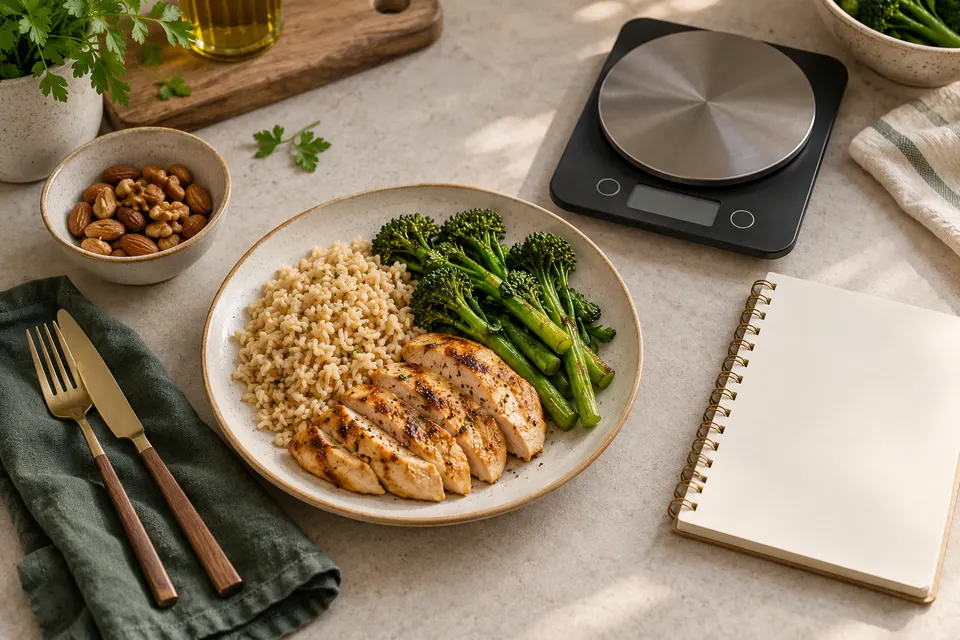
Consider a meal built from chicken, rice, vegetables, and oil. In Simple Serving Mode, choose portions from the manual's food tables and count the protein, smart-carb, vegetable, and fat exchanges used. Do not assume any chicken-and-rice plate automatically equals one of each.
In Precision Mode, record the amounts of the actual ingredients and use matching nutrition entries, including the oil. A cooked-rice portion needs an entry for cooked rice. Keep labels or recipe amounts consistent when you batch-cook, so tomorrow's meal is comparable to today's.
The manual's simple plate template is one protein, one smart carb, one vegetable, and zero or one fat serving. That is a meal-building example, not a daily prescription or a fixed calorie total. Your overall plan still determines how meals fit together.
Read the calculator's formula, assumptions, and worked example
More numbers do not guarantee more accuracy
Precision Mode is useful if you want to inspect portions and meal patterns in detail. Be consistent about entries for raw versus cooked food, check package information, and include the items you might otherwise overlook. A precise-looking total can still be based on incomplete inputs.
The calculator uses fixed assumptions for activity and fat-loss pace. Treat the result as a starting estimate. It cannot account for every individual's body composition, health needs, or daily activity. Its methodology page explains exactly what it calculates.
Choose a method for the next review period
If detailed logging is the obstacle that repeatedly ends your routine, try learning the serving system. If you enjoy recording food and want to troubleshoot portion sizes, the more detailed mode may suit you.
The serving system uses a two-week review period. First check whether you followed the chosen portions, logged extras, and kept similar routines. Then review training, hunger, energy, and longer-term measurements. A difficult week is useful information, not an instruction to cut food immediately. Avoid changing the method and the target simultaneously whenever possible.
When a general method is not enough
A general fitness program cannot set medical nutrition targets. A dietitian or clinician can help when you have a condition affecting food choices, are pregnant or breastfeeding, or have a history of disordered eating. If tracking makes eating feel increasingly distressing or compulsive, seek support rather than adding more tracking rules.
Sources and program context
Keep learning
Put the first two weeks on your calendar
Get the free starter with six workouts, equipment options, food basics, and a Day 1 baseline.
Start with 14 days free